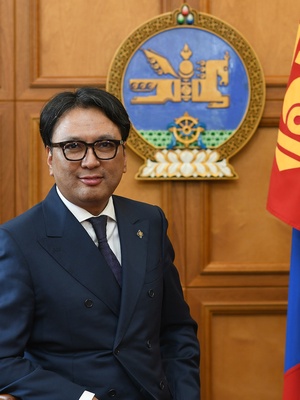
Assessment
Dorjkhand is a serving deputy prime minister and parliamentarian, giving him both executive and legislative standing. His career combines fiscal-policy work at the Ministry of Finance, public-debt management, international programme coordination, service at the International Monetary Fund, and leadership of the HUN Party’s governing board. This makes him a material interlocutor on national economic administration and intergovernmental policy coordination.
Power and influence
His current formal authority is anchored in the deputy prime ministership, held since 2024, alongside membership of parliament and the Standing Committee on State Structure. Earlier leadership of the HUN Party governing board from 2016 to 2020 adds relevant political-organizational experience. The packet does not define his cabinet portfolio, delegated authorities, cabinet committee roles, or his current formal position within the party.
Key relationships
Dorjkhand’s meaningful formal relationships include the HUN Party, the Government of Mongolia, parliament, the Ministry of Finance, and his former International Monetary Fund advisory role. He also coordinated the United Nations Millennium Village Programme and an Asian Development Bank Central Asia Regional Economic Cooperation programme while at the ministry. These are institutional and professional connections; no personal, family, or commercial-partner relationships are evidenced.
Commercial interests
The supplied 2024 disclosure contains no investment or asset entries. It records personal income of MNT 91.254 million and household income of MNT 116.662 million. Accordingly, the packet does not evidence corporate holdings, beneficial ownership, directorships, assets, or sector-specific commercial interests. His documented experience is predominantly in public finance, debt management, international institutions, party organization, and elected office.
Policy profile
His evidenced policy profile centres on public finance, fiscal and debt policy, development finance, international economic cooperation, and state governance. Ministry of Finance appointments included budget policy, loans and aid policy, financial policy, and debt management; his IMF role covered Asia-Pacific countries. His current State Structure committee membership adds governance exposure. The packet provides no stated positions, voting record, or policy programme.
Recent developments
The most recent material change was Dorjkhand’s assumption in 2024 of the deputy prime ministership while continuing as a parliamentarian following the 2024 election. This moved him from a solely legislative role in 2020–2024 into a concurrent cabinet and legislative position. The evidence does not specify his responsibilities as deputy prime minister or any resulting change in his HUN Party role.
Concerns and unknowns
The packet includes one 2024 disclosure only, with no listed assets or investments, so it cannot establish financial trends or external commercial exposure. It does not identify the deputy prime minister’s assigned portfolio, current HUN Party office, cabinet responsibilities, parliamentary leadership role, beneficial ownership, or conflict-management arrangements. Lack of entries in the supplied data should not be treated as proof of absence.